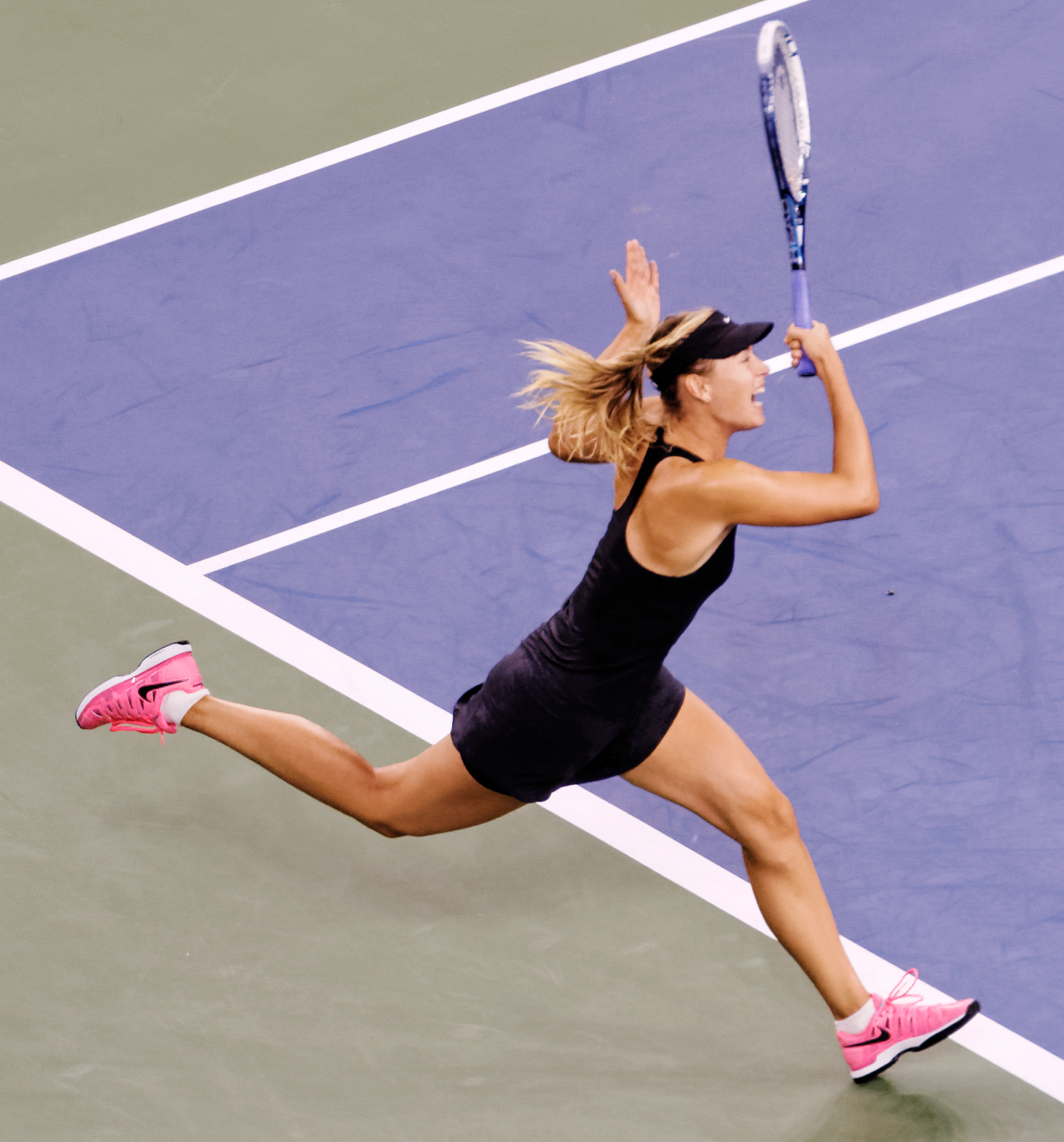
The Forehand
The forehand is the most powerful and most-used shot in modern tennis. For a right-handed player, it is hit on the right side of the body; for left-handers, on the left. It is typically the dominant weapon and the shot most players try to run around to use as often as possible.
Technique
- Grip: Eastern, Semi-Western, or Western grip — the more "Western" the grip (racket handle turned more towards you), the more topspin you can generate.
- Stance: Start with a split step as your opponent hits, then pivot to a sideways or semi-open stance facing the incoming ball.
- Backswing: Take the racket back early. Loop the racket head down and back before coming forward and up through the ball.
- Contact: Hit the ball in front of your body, roughly at waist height. Your non-dominant arm should point toward the ball as it approaches.
- Follow-through: Finish high across your body, your racket ending up near your left shoulder (for right-handers). This promotes topspin and direction control.
The Backhand
The backhand is hit on the non-dominant side of the body. There are two main variations: the one-handed backhand and the two-handed backhand.
Two-Handed Backhand
The two-handed backhand (used by Sharapova, Andy Murray, Serena Williams, Novak Djokovic) provides more stability and power, especially for players who are still developing. Both hands stay on the racket through contact.
- Grip: Dominant hand uses a Continental grip; non-dominant hand uses an Eastern forehand grip above it.
- Contact: Hit the ball slightly in front of your body, around hip to waist height.
- Follow-through: Extend through the ball and finish high over the opposite shoulder.
One-Handed Backhand
The one-handed backhand (used by Roger Federer, Stefan Edberg, Stan Wawrinka) allows greater reach, a more versatile slice, and is considered more aesthetically elegant. However, it is harder to generate power against high balls.
- Grip: Eastern backhand or Semi-Western backhand grip.
- Contact: Turn sideways and reach forward, keeping the non-dominant hand on the throat of the racket until the forward swing begins.
- Follow-through: Extend the arm fully through the ball, finishing high on the follow-through.
The Serve
The serve is the only shot in tennis where you have complete control — no opponent, no incoming ball to react to. It is the most important weapon in your game and deserves the most practice. See our dedicated Serve Guide for full technique breakdown.
Types of Serves
- Flat serve: Maximum pace with minimal spin. Goes straight through the court at high speed. High risk (less margin), high reward. Maria's primary weapon was a flat first serve.
- Slice serve: Sidespin that makes the ball curve to the side. Excellent for pulling opponents wide, especially out to the doubles alley on the right side. Very useful second serve to wrong-foot opponents.
- Kick (topspin) serve: Heavy topspin causes the ball to bounce high. The safest second serve at the professional level. Forces opponents to deal with a bouncing ball near the shoulder.
The Volley
A volley is hit before the ball bounces — usually near the net. Volleys are about quick hands and smart positioning rather than big swings.
- Grip: Continental grip (the universal grip for volleys — allows you to handle both sides without changing grip).
- Technique: Short compact punch — never take a big backswing. Step into the ball and use a firm wrist. Think of catching the ball on the strings rather than swinging through it.
- Positioning: Position yourself inside the service box, roughly halfway between the service line and the net (the "ideal volley position").
The Overhead (Smash)
The overhead is your response to a lob — a high ball your opponent sends up over your head trying to get it over you when you're at the net. It looks like a serve motion, and for good reason.
- Footwork: Move back quickly using cross-steps or sidesteps (never backpedal). Get behind the ball.
- Preparation: Raise the non-dominant hand to point at the ball, bring the racket back behind your head (trophy position).
- Contact: Hit the ball at full extension above your head. Make contact in front of your body.
- Direction: Aim for open spaces — usually the opposite diagonal from where your opponent is.
The Drop Shot
The drop shot is a delicate shot designed to barely clear the net and land as close to the net as possible on the opponent's side, making it nearly unreturnable unless the opponent is right at the net.
- When to use: When your opponent is deep behind the baseline, when you have a short ball, or as a change-of-pace tactic.
- Technique: Set up to look like you're hitting a normal groundstroke, then at contact, slow the racket dramatically and add underspin (slice) to deaden the ball.
- Direction: A cross-court drop shot gives you more net to clear but is safer; a down-the-line drop shot is riskier but harder to run down.
The Lob
The lob sends the ball high over the opponent's head when they are at the net, forcing them back or winning the point outright.
- Defensive lob: Hit when you are out of position and need time. Hit high and deep to reset the point.
- Offensive topspin lob: Hit with topspin to bring the ball down quickly after it clears the net player's reach. Used as an attacking shot to win the point, not just buy time.
The Slice
The slice (or underspin groundstroke) is hit with the racket moving through the ball from high to low, imparting backspin. The ball stays low after bouncing and moves more slowly through the air.
- Forehand slice: Less common but useful for low balls and change-of-pace.
- Backhand slice: One of the most useful shots in tennis, especially for one-handed backhand players. Used to handle high balls, approach the net, change the pace of a rally, and as a defensive reset.
- Slice serve: The slice used on the serve to generate sidespin (described above).
The Half-Volley
A half-volley is a shot taken right as the ball is rising from the bounce — a difficult skill shot that occurs when you are caught at an awkward position (usually just inside the service line) and can't let the ball come up fully. Aim for consistency over power in this shot — just get it back over the net deep.
Shot Selection: Which Shot When?
| Situation | Best Shot Option |
|---|---|
| Opponent deep behind baseline | Drop shot |
| Opponent rushing the net | Lob (over them) or passing shot (wide of them) |
| Short ball in mid-court | Aggressive groundstroke, then approach net |
| Very high bouncing ball | Step around and use forehand, or two-handed backhand |
| Low, skidding ball | Slice to keep it low, or lift with topspin |
| Ball at net height | Volley with a firm punch |
| Lob coming toward you at the net | Overhead smash |
| Need to change pace of rally | Slice or drop shot |